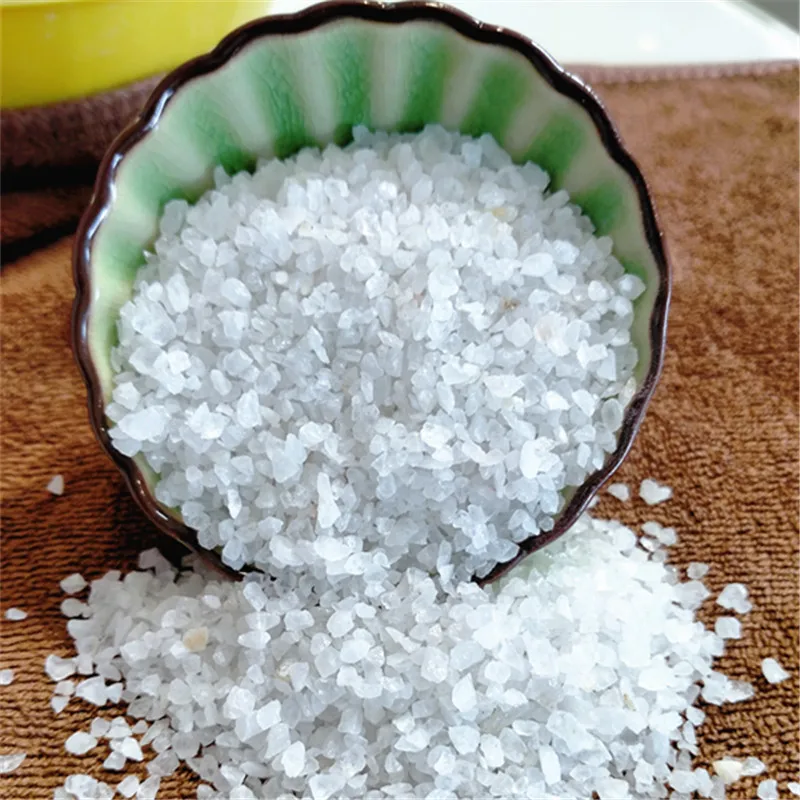
Key Advantages of Quartz Sand
● Exceptional Hardness and Durability
Quartz sand retains quartz’s inherent hardness, ranking 7 on the Mohs scale—far harder than common alternatives like river sand or limestone sand. This hardness makes it highly resistant to scratches, crushing, and wear, even under prolonged mechanical stress. Whether used in construction mixing or industrial grinding, it maintains its granular structure without breaking into fine powder, unlike softer sands that degrade quickly. This durability reduces the need for frequent replacements, cutting long-term costs, and makes it reliable for high-demand scenarios like concrete aggregates and water filtration systems.
● Superior Chemical Inertness
Quartz sand boasts strong chemical stability, rarely reacting with most acids, alkalis, salts, or organic solvents at normal temperatures. It won’t dissolve, discolor, or release harmful substances when in contact with household cleaners, industrial coolants, or natural water. This solves the corrosion issues plaguing other sands: in water treatment, it doesn’t contaminate effluent by reacting with impurities; in coatings, it doesn’t affect adhesion by interacting with paint components. For industries like chemical engineering and environmental protection, this means no extra anti-corrosion treatments—just low-maintenance, consistent performance.
● Excellent Thermal Stability
With a high melting point (around 1713°C) and strong thermal shock resistance, quartz sand avoids softening, deforming, or cracking under high temperatures or sudden temperature changes. It outperforms ordinary sands (e.g., river sand that sinters easily) in withstanding moderate-to-high heat, making it vital for high-temperature industries. In glass manufacturing, it stays stable during melting to ensure transparency; in foundries, it maintains casting mold shapes without collapsing under molten metal. It also enhances safety in thermal insulation and fire-resistant coatings.
● Controllable Consistency
Unlike natural sand (with irregular sizes and variable impurities), quartz sand is processed into precise particle sizes (from tens of microns to millimeters) via crushing and screening. Its silica content often exceeds 99%, with minimal impurities like iron oxide. This consistency is key for large-scale production: uniform sizes ensure concrete’s compressive strength; high purity prevents interference in semiconductor manufacturing. It can also be customized to meet specific needs, adapting to both precision electronics and heavy construction.
● Non-Porous Hygiene
Purified quartz sand has a dense, non-porous surface that doesn’t absorb liquids, bacteria, mold, or stains. Spills (water, food residues, biological fluids) wipe away easily, no odor or contamination left. This makes it ideal for clean-sensitive scenarios: in food processing, it filters edible oils without microbial risk; in aquaculture, it acts as a fish tank substrate that avoids waste buildup. Unlike porous sands requiring frequent disinfection, it stays hygienic with simple rinsing.
Practical Applications of Quartz Sand
● Construction
As a foundational material, it strengthens concrete, mortar, and asphalt—boosting compressive strength and frost resistance for high-rises, bridges, and roads. It’s also key in engineered stone (e.g., quartz countertops, mixed with resin) and wall tiles, ensuring uniform thickness and scratch resistance. Fine quartz sand improves adhesion in coatings and putties, extending building lifespans.
● Glass & Ceramics
Making up 60%-70% of ordinary glass, it ensures transparency and stability during melting, used for window glass, bottles, and specialty glass (e.g., heat-resistant borosilicate). In ceramics, it reduces firing shrinkage to prevent cracking (in bodies) and enhances glaze gloss/hardness (for kitchenware and sanitary ware).
● Water Treatment
A top filtering medium for municipal sewage, industrial wastewater, and drinking water, its uniform particles trap sediments without reacting with water. It’s reusable via backwashing, cutting costs, and aids soil remediation by improving permeability and adsorbing heavy metals.
● Electronics
High-purity quartz sand (99.999% silica) becomes quartz wafers (semiconductor substrates), crucibles (for single-crystal silicon growth), and optical fibers. Wafers avoid signal interference; crucibles withstand ultra-high temperatures without contaminating silicon; fibers enable low-loss data transmission for high-speed internet.
● Industrial Abrasives
Its hardness makes it ideal for sandblasting (cleaning metal/wood without damage), sandpaper (smoothing wood), and grinding wheels (metal finishing). In mining, it acts as a hydraulic fracturing proppant to keep oil/gas wells open.
● Foundry & Metallurgy
Used for sand molds in casting (iron, steel, aluminum), it retains shape under molten metal and avoids reactions. In steelmaking, it acts as a flux to form slag, removing impurities and improving steel purity. It also makes heat-resistant firebricks for metallurgical furnaces.
● Cosmetics
Fine, pure quartz sand is a gentle exfoliant in facial scrubs, body washes, and toothpaste—removing dead skin and polishing enamel without micro-tears. It also enhances stain removal in laundry detergents as an abrasive.
 EN
EN