EN
EN


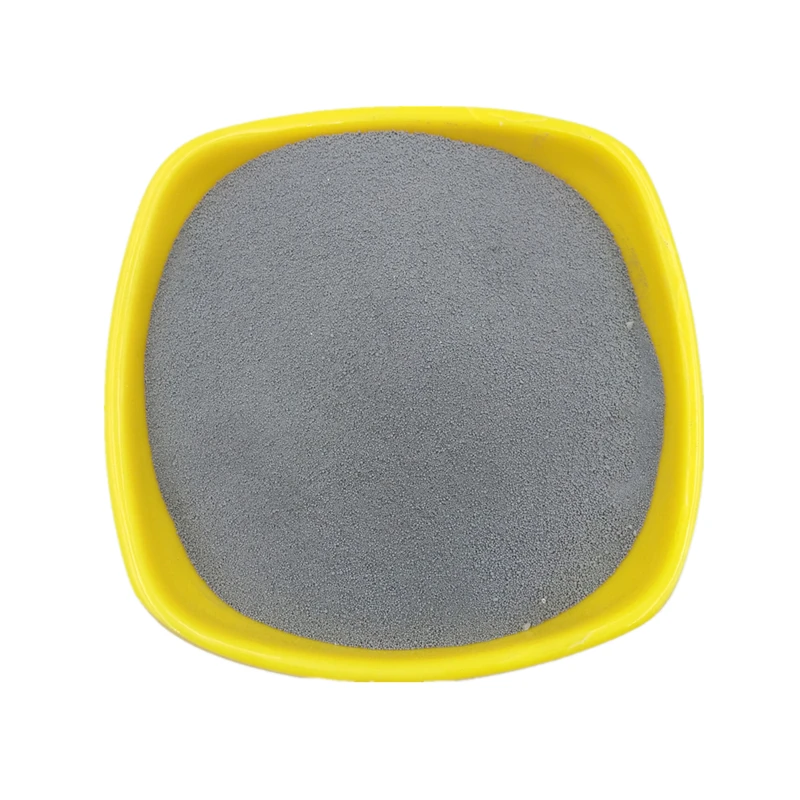
Micro silica, also known as silica fume, exhibits exceptional pozzolanic activity, meaning it reacts with calcium hydroxide in cementitious materials to form additional calcium silicate hydrate (CSH) gel. This reaction enhances the strength and durability of concrete and other cement-based products, creating a denser matrix that resists permeability. Unlike regular silica sand, Micro silica’s ultra-fine particle size (typically 0.1 to 0.3 microns) allows it to fill tiny gaps between cement particles, improving overall packing density. This pozzolanic activity ensures Micro silica actively contributes to the structural integrity of materials, rather than acting as a passive filler, making it a high-performance additive in construction.
Micro silica’s ultra-fine particle size gives it an extremely high surface area, which amplifies its reactivity and bonding capabilities. With a surface area up to 20,000 m²/kg, Micro silica can disperse evenly throughout mixtures, ensuring uniform reaction and strengthening. This fine particle size allows Micro silica to fill micro-pores in concrete, reducing permeability to water, chemicals, and chloride ions. Unlike coarser additives that may create weak points, Micro silica integrates seamlessly into matrices, enhancing cohesion and reducing shrinkage. Its ability to fill voids at a microscopic level makes Micro silica indispensable for producing high-strength, dense materials.
Adding Micro silica to cementitious materials significantly improves mechanical properties, including compressive strength, flexural strength, and abrasion resistance. Concrete containing Micro silica can achieve higher early and ultimate strength, allowing for faster construction cycles and reduced material usage. Its inclusion also enhances toughness, making materials more resistant to impact and fatigue. Unlike some strength-enhancing additives that increase brittleness, Micro silica balances strength with durability, ensuring long-term performance in demanding environments. This improvement in mechanical properties makes Micro silica a preferred choice for high-performance concrete in bridges, dams, and industrial structures.
Micro silica enhances the chemical resistance of materials by reducing permeability and forming a denser microstructure. It minimizes the ingress of aggressive substances such as sulfates, acids, and chloride ions, which can cause corrosion of steel reinforcement in concrete. This resistance makes Micro silica-treated materials ideal for harsh environments, including coastal areas, wastewater facilities, and industrial plants. Unlike untreated concrete that is prone to chemical attack, Micro silica-modified mixtures maintain their integrity over time, reducing maintenance costs and extending service life. Its ability to protect against corrosion ensures structural safety in chemically challenging settings.
Micro silica is highly compatible with various cementitious materials, additives, and aggregates, making it versatile across industries. It works effectively with Portland cement, fly ash, slag, and chemical admixtures, enhancing performance without causing adverse reactions. Micro silica can be used in precast, ready-mix, and shotcrete applications, adapting to different production methods and project requirements. Its compatibility with other materials allows for customized formulations, whether targeting high strength, low permeability, or improved workability. This versatility ensures Micro silica can be integrated into diverse projects, from residential construction to large-scale infrastructure.
Micro silica is widely used in high-performance concrete to enhance strength and durability. It is a key ingredient in high-strength concrete (HSC) and ultra-high-performance concrete (UHPC), where it enables compressive strengths exceeding 100 MPa. In bridge decks, columns, and high-rise buildings, Micro silica reduces permeability, protecting steel reinforcement from corrosion and extending structural life. It is also used in precast concrete elements, such as beams and panels, to improve dimensional stability and reduce shrinkage cracks. Micro silica’s ability to enhance workability in high-cement-content mixtures makes it valuable for complex architectural concrete with intricate forms. Its role in high-performance concrete ensures structures can withstand heavy loads and harsh conditions.
In refractory materials, Micro silica improves heat resistance and structural integrity at extreme temperatures. It is added to refractory castables, bricks, and mortars used in furnaces, kilns, and incinerators. Micro silica enhances the hot strength of refractories, preventing spalling and deformation under thermal stress. Its fine particles fill gaps in refractory matrices, creating a dense structure that resists molten metal penetration and chemical attack. In foundries, Micro silica-containing refractories line ladles and tundishes, ensuring reliable performance during metal casting. Micro silica’s contribution to refractory performance makes it essential for industries relying on high-temperature processes, such as steel, glass, and cement manufacturing.
Micro silica is critical in shotcrete (sprayed concrete) applications, particularly in tunneling, mining, and underground construction. It improves the cohesion and adhesion of shotcrete, reducing rebound (waste material) and ensuring uniform coverage on rock or soil surfaces. Micro silica enhances early strength development, allowing shotcrete to quickly support underground structures and prevent collapses. Its low permeability makes shotcrete with Micro silica effective at sealing groundwater infiltration in tunnels and mines. In slope stabilization and retaining walls, Micro silica-treated shotcrete provides durable, erosion-resistant protection, ensuring long-term stability in challenging geotechnical conditions.
Micro silica is used in grouts and concrete repair materials to improve bonding and durability. It enhances the strength and fluidity of injection grouts, allowing them to penetrate fine cracks and voids in damaged concrete. In structural repairs, Micro silica-containing repair mortars bond strongly to existing concrete, restoring structural integrity and preventing further deterioration. It is also used in floor leveling compounds and industrial toppings, providing a smooth, abrasion-resistant surface that withstands heavy traffic. Micro silica’s ability to reduce shrinkage in grouts ensures tight, long-lasting seals in joints and connections, making it valuable for infrastructure rehabilitation projects.
In the oil and gas industry, Micro silica is used in cementing operations to enhance wellbore integrity. It is added to oil well cement to reduce permeability, preventing gas and fluid migration between formations. Micro silica improves the compressive strength of well cement, ensuring it can withstand downhole pressures and temperatures. In offshore drilling, it enhances cement durability in saltwater environments, protecting against corrosion and ensuring well stability. Micro silica is also used in concrete for oil and gas facilities, such as storage tanks and processing plants, where chemical resistance and structural strength are critical. Its role in the oil and gas industry supports safe, efficient energy production.
Micro silica is incorporated into ceramics and composite materials to improve strength and thermal properties. In ceramic production, it reduces firing shrinkage and enhances densification, resulting in stronger, more uniform ceramic products. Micro silica is used in advanced composites, such as fiber-reinforced polymers (FRPs), to increase mechanical strength and thermal stability. It acts as a filler in ceramic coatings, improving adhesion and wear resistance on metal surfaces. In electronic ceramics, Micro silica enhances dielectric properties, making it suitable for insulators and circuit components. Its contribution to ceramics and composites expands its applications beyond construction, supporting innovation in manufacturing and technology.