 EN
EN


Why Industrial Quartz Sand Is Uniquely Suited for High-Demand Industrial Use
Silica Purity, Grain Hardness, and Thermal Stability as Foundational Properties
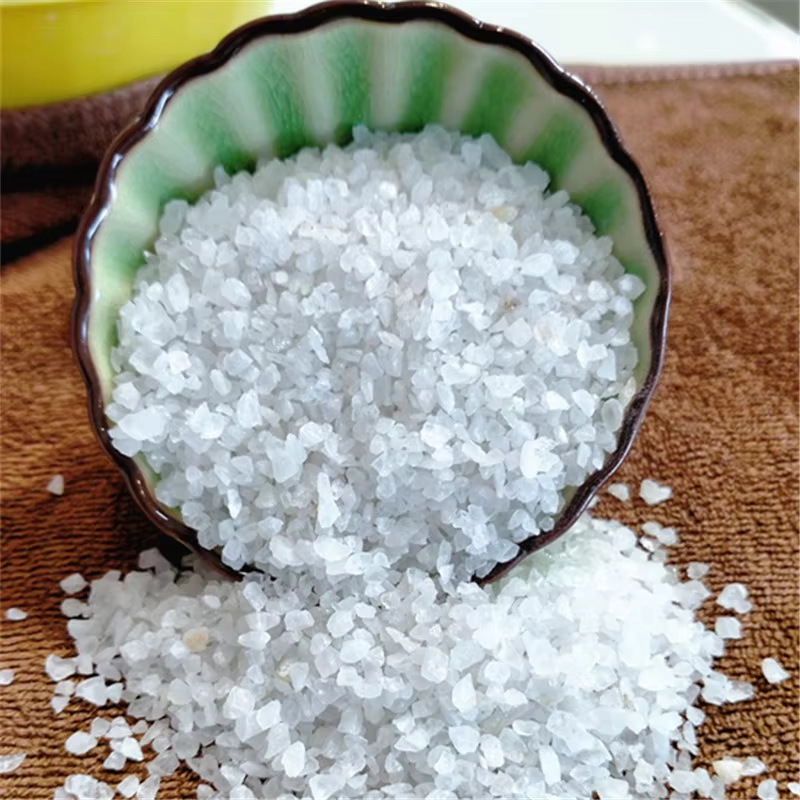
Industrial quartz sand excels in high-stakes applications due to three interlocking properties: exceptional silica purity, inherent grain hardness, and outstanding thermal stability. With SiO₂ content typically exceeding 99.5%, it contains minimal reactive impurities—critical for preventing contamination or unwanted reactions during high-temperature processes like glass melting or ferrous metal casting. Its Mohs hardness of 7 delivers robust resistance to abrasion and particle degradation, ensuring long-term performance in demanding roles such as filtration media or high-strength concrete aggregates. Most critically, it retains structural integrity above 1,700°C—enabling reliable use in foundry molds exposed to molten iron or steel. Together, these intrinsic traits make industrial quartz sand a uniquely stable, predictable, and versatile foundation across extreme industrial environments.
Key Specifications: Grain Size Distribution, Fines Content, and Contaminant Limits
Functionality hinges on tightly controlled physical specifications—not just composition. Advanced classification ensures consistent grain size distribution (commonly 0.1–0.6 mm), which governs packing density in foundry molds and flow behavior in cementitious systems. Fines content—particles under 75 µm—is rigorously limited to prevent reduced permeability in resin-bonded cores and excessive water demand in mortars. Contaminants like clay, iron oxides, and alkaline minerals are minimized through magnetic separation, scrubbing, and acid leaching, safeguarding against binder interference, erratic setting, and efflorescence. These parameters align with authoritative standards including ASTM C144 for masonry sands and AFS (American Foundry Society) specifications for foundry-grade silica—ensuring interoperability, reliability, and regulatory compliance across supply chains.
Foundry Applications of Industrial Quartz Sand
Green Sand Molding: Reusability, Compaction Behavior, and Cast Surface Quality
Green sand molding—the dominant process in global ferrous and non-ferrous foundries—relies fundamentally on industrial quartz sand’s angular grain shape, high purity, and compaction consistency. Its ability to form dense, thermally stable molds enables precise replication of complex geometries while resisting deformation during molten metal pour. Crucially, spent sand can be reconditioned onsite with modest additions of bentonite clay, water, and coal dust, supporting reuse rates up to 95% within a single facility. This circularity significantly lowers raw material costs and landfill burden. Optimal grain size distribution ensures balanced mold permeability and green strength—reducing defects like blowholes and scabs—while delivering castings with tight dimensional repeatability and smooth surface finishes. These attributes make green sand the go-to choice for high-volume, mission-critical components such as automotive engine blocks and hydraulic pump housings.
Resin-Bonded Systems: Dimensional Accuracy and Core Strength in Complex Castings
Where green sand reaches its limits—in thin-walled, highly detailed, or internally complex castings—resin-bonded systems leverage quartz sand’s thermal stability and low coefficient of thermal expansion. Thermosetting resins coat the uniform, angular grains to create rigid, heat-resistant cores and molds that hold fine features without distortion. The result is up to 50% greater dimensional accuracy versus green sand, enabling near-net-shape production of cylinder heads, valve bodies, and manifold cores with minimal post-cast machining. Quartz sand’s chemical inertness prevents reaction with molten alloys, preserving metallurgical integrity, while its consistent surface chemistry ensures even resin dispersion and optimal cure kinetics. Though resin adds cost, the gains in precision, design freedom, and yield justify adoption in aerospace, energy, and high-performance automotive applications.
Construction Applications of Industrial Quartz Sand
High-Performance Concrete and Mortar: Enhancing Strength, Workability, and Durability
In high-performance concrete and mortar, industrial quartz sand serves as a premium fine aggregate whose physical and chemical consistency directly elevates structural outcomes. Its high SiO₂ content, angular morphology, and narrow particle size distribution optimize intergranular packing—reducing voids in the cement paste matrix and boosting compressive strength by up to 15% compared to standard river sands. Low clay and fines content ensure predictable rheology and superior workability, especially critical in self-consolidating concrete (SCC) and precast applications. Critically, its chemical inertness suppresses alkali-silica reaction (ASR), while its thermal stability enhances resistance to freeze-thaw cycling and sulfate exposure. These advantages support longer service life, lower maintenance, and compliance with durability-focused codes like ACI 318 and EN 206—making quartz sand indispensable for infrastructure, high-rise façades, and pre-stressed elements.
Sustainable Use of Recycled Foundry Sand in Flowable Fill and Base Layers
Recycled foundry sand—thermally reclaimed and screened to remove residual binders and organics—has emerged as a high-value, sustainable alternative in construction. Its well-graded, angular particles and chemical stability make it ideal for controlled low-strength material (CLSM), where it replaces natural sand without compromising flow control, early strength gain, or long-term stability. In road base and subbase layers, it provides reliable load-bearing capacity and drainage performance comparable to virgin aggregates—validated by state DOT specifications in over 30 U.S. jurisdictions. This reuse diverts millions of tons annually from landfills, cuts demand for environmentally disruptive river sand mining, and reduces embodied carbon by up to 40% per ton of replacement. It exemplifies cross-sector circularity: a waste stream from metalcasting becomes an engineered resource for resilient infrastructure.
Cross-Industry Innovation: Circular Integration and Future-Proofing Supply Chains
Industrial quartz sand producers are advancing beyond linear extraction models—embedding traceability, collaboration, and regeneration into core operations. Digital material passports and blockchain-enabled platforms track sand from quarry to foundry to construction site, enabling verified closed-loop recycling: thermally reclaimed foundry sand is reintegrated into CLSM, stabilized base courses, or even new green sand blends. Joint R&D with foundries and civil engineering firms has yielded ASTM-recognized protocols for recycled sand acceptance, helping cut virgin material use by up to 30% without sacrificing performance. Regional processing hubs reduce transport emissions, while standardized testing frameworks—aligned with ISO 14040 and EN 15804—support transparent ESG reporting. These integrated strategies don’t just mitigate resource risk; they transform waste liabilities into value streams, strengthening resilience across both manufacturing and construction ecosystems.