EN
EN


Silica powder is an important part of the manufacturing, construction, and technology ceramics, electronics, water treatment and construction. A reliable factory of Silica powder is needed in order to maintain the quality of supplied products, stability in production and profit in business. In order to choose the right partner, a complete the silicate powder market. There is a step when finding an authentic partner. This blog accompanies you through the necessary steps to help find a business that matches your long-term needs.
Check Factory’s Documents
Check the certificates and qualifications of the factory. Start confirming the validity of the business and the credentials such as business registration certificates, tax documents, and operate the factory as a registered business entity. In order to get approvals andThe ISO 9001 (Quality Management System) international certification, for instance, confirms that the factory has developed quality control processes for every stage, starting from sourcing raw materials to delivering the end product. If your business offers exportation or needs to meet international business standards, certificates issued by third-party organizations such as SGS would be important. Take the case of Shijiazhuang Shengping Minerals Co., Ltd. which holds an Alibaba Verified Gold Plus Supplier Certificate issued by SGS for the period of July 2025 to July 2026. Such certifications are a testament that the factory has passed stringent international onsite inspections and certified for quality and ethical standards which are essential for long term credibility and trust.
In addition, examine the factory for product related certifications such as OSHA certification for compliance with the Hazard Communication Standard (29 CFR 1910.1200) for Chemical Safety. A reputable factory should and would be able to provide Safety Data Sheets (SDS) for its silica powder products that inform users about the level and classes of hazards along with handling precautions and first aid measures which are important and vital in the safety of the workplace as well as compliance with laws.
Assess Production Capacity and Technical Strength
Effective and long term cooperation needs a factory that will be able to keep up with the supply needs of your growing business. Therefore, evaluating the factory's supply capacity along with its technical capabilities will be important in overcoming shortages or quality disruptions.
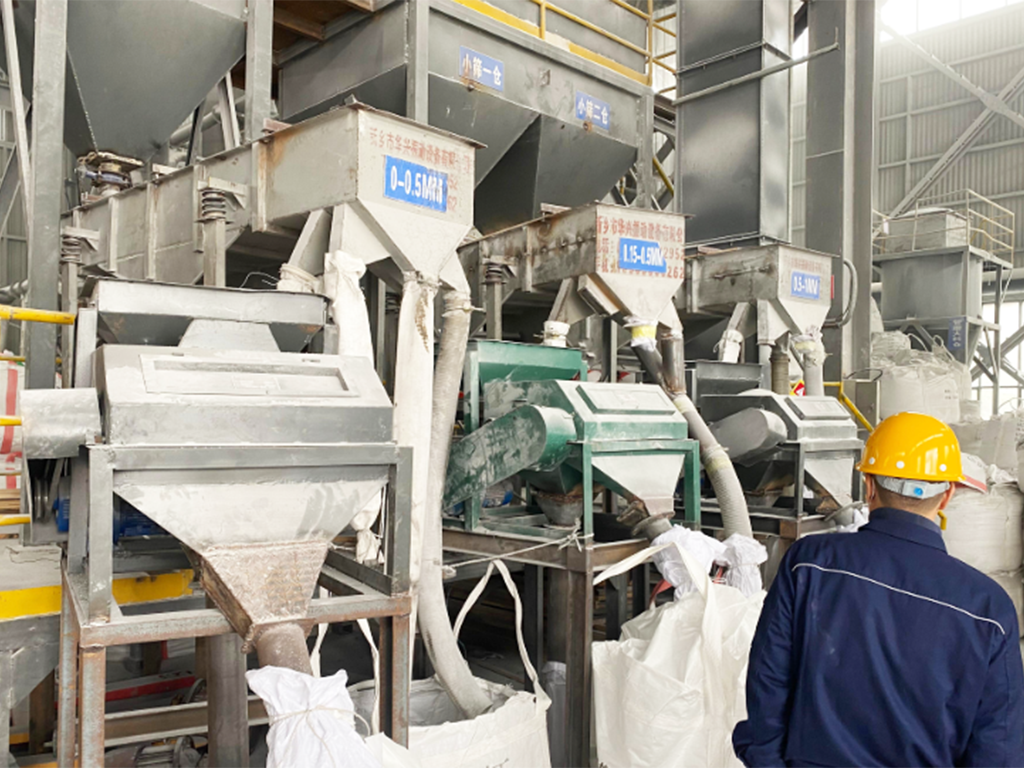
Ask for details like the production area, annual output, and equipment that the factory has. For instance, production facilities that are over 10,000-square meter and can output over 100,000 tons annually are capable of handling and growing bigger than other smaller facilities, such as Shijiazhuang Shengping Minerals Co., Ltd. This is in addition to the type of machinery used, such as professional by high quality grinders, seives, and magnetic separators that are essential in a production facility. Such facilities that have such machinery are guaranteed to have good production levels and good product quality.
No less important than the equipment is the technical strength of the factory. Thought highly of, a factory needs to have professional staff that can carry out R&D in production processes and product planning and even design tailor solutions for the factory's needs. Cases in point for such capabilities are eficiency in processing silica granules to desired sizes of 40-70 mesh for water purifications or 325 mesh for ceramic glaze as well as removing unwanted materials to have sio2 of 99.86% or more. Do such basic questions of whether they do in-house testing or are in partnership with testing agencies to do quality control checks. This is important in ensuring that each lot of silica powder produced meets the requirements such as moisture in the batch, insoluble in water, Fe2O3 diffused at 0.0015% and below as illustrated in testing done by Foshan Youbo Ceramic Analysis and Testing Co., Ltd.
Assess Product Quality and Quality Control Mechanisms
The essence of long-term partnerships is due to product quality assurance. A dependable producer of silica powder is expected to have a quality assurance protocol in place to vet and address quality issues associated with each phase of the production process, including selection of raw materials and final packaging.
Start with a request for samples and a comprehensive summary of the various test results. For silica powder, the relevant quality parameters are the content of silica, content of impurities such as iron, calcium, and others, particle size distribution, the physical characteristics like moisture, density and the degree of whiteness, and chemical properties like pH and oil absorption. A reliable manufacturer will have sample test reports done by a qualified third-party testing laboratory to prove the given parameters. If the factory only offers self-reported results and no independent verification, then that factory should not be considered. For instance, if the silica powder is to be used for sophisticated ceramics, then the factory that is likely to meet the quality requirements is the one that can provide the test report of 93.7% natural whiteness and 0.03% residue of 325 mesh sieve, like the products of Shijiazhuang Shengping Minerals Co., Ltd.
Ask the factory if they have quality checks on raw materials before production. Do they perform any in-process testing (like identifying particle sizes during grinding)? Is there a last check before products leave the factory? Is there a standard last check before products leave the factory? A robust QC system (e.g., raw material purity, grinding parameter control, sieving particle size) ensures that every batch of silica powder made is consistent. This minimizes the chance of defective products clogging up your manufacturing process.
Customized particle sizes, special packaging, branded logos—it doesn’t matter what it is, every business has different needs. A factory with good customization capabilities would be willing to meet all your needs, thus proving to be a more beneficial partner in the long run.
Ask the factory if they offer ODM (Original Design Manufacturer) or OEM (Original Equipment Manufacturer) services. For example, to what extent can they modify the purity of silica powder to suit your application (95% SiO₂ for general construction versus 99.8% for electronics) and tailored pack it in bags with your company logo? Shijiazhuang Shengping Minerals Co., Ltd., for instance, offers logo customization on products, packaging, and bespoke design based products. This streamlines your supply chain and enhances brand cohesion.
The service levels is another crucial aspect. For long lasting partnerships, companies need to do much more than just supply products. There is critical need for communication, and customer service afterwards. Look at the factory’s pre-sales service. Do the sales personnel understand your industry and your needs? Can they provide some technical assistance, for example, telling which grade of silica powder is suitable for your ceramic glaze recipe? For the after-sales service, what is their policy is on the quality complaints? Do they investigate the problem, and offer to replace, or pay for the losses sustained? A factory that offers one-to-one exclusive service (as for example, offered by Shijiazhuang Shengping Minerals Co, Ltd) and is reachable at designated times (say, 8:00 am to 12:00 noon during the week and 8:00 am to 10:00 pm during the weekend) ensures that problems are dealt with immediately, and your production downtimes are minimal.
Check The Market Reputation and Customer Issues
A factory’s reputation and track record about customer satisfaction is very important for determining trust. You need to do your own assessment of the factory’s reputation before deciding on a long-term partnership.”
Begin with searching different websites: if the factory is active on B2B sites such as Alibaba, check out the supplier ratings, customer comments, and the transaction analytics from the customer. Review feedback from clients pertaining to your field. For instance, if a water treatment stock claims that a factory’s silica sand consistently filters water, it is a good sign if you also work with water treatment.
In addition to this, you can request the factory to provide any referrals from long term clients. Talking to such clients gives you the opportunity to find out whether: the factory meets its deadlines, if the product quality remains unchanged throughout the association, and the manner in which the factory deals with any abrupt surpluses or deflation in the market. It is best to stay away from such factories that have a high reluctance to provide details of the clients, or that have a long history of negative comments such as constant delays, poor quality control, as well as negative service.
Also, think about how long the factory has been in business. A factory that has been in business for more than a decade, such as Shijiazhuang Shengping Minerals Co., Ltd. that has been in active since 2014, is likely to have gone through the ups and downs of the market, solved the most common production problems, and created a stable supply chain. This is in comparison to factories that have just been set up and do not have the necessary expertise to deal with any problems.
Review Pricing Transparency and Collaboration Terms
Although economics is not the only consideration, the pricing transparency and equitable cooperation terms are critical for the long-term, mutually advantageous partnerships. A reputable silica powder factory should offer pricing transparency and accuracy without hidden costs (e.g., unexpected customization, packaging, and transportation fees).
When negotiating, pricing ask for a granular analysis like what determines a price, and how is a price affected by the purity, particle size, and order quantity? What is offered in terms of price if the factory gives long-term, large-quantity orders? Factories that offer a price that is unusually low should be avoided because this is a sign of undesirable quality like excessive impurity levels and inconsistent particle sizes, or high concealed costs that will increase the overall expenditure in the future.
Equally important are the cooperation terms. Each contract should be reviewed with the intention of clarifying the means of payment, the time of payment, the time of delivery, the quality of the product, the terms of the disagreement, and the liability of each clause. For example, does the contract have an MOQ and does it match with your needs? Do you have an on time guarantee (e.g. penalties for being late)? How are quality disputes resolved (e.g. third party testing to verify the issue)? A factory willing to negotiate flexible terms (e.g. any MOQ for small-batch trials, any time payment for long-term customers) indicate that you are valued and that the intention is to partner for an extended duration.
Finding a dependable silica powder factory for long-term cooperation means going through a qualifications plus production capacity, QC, customization, reputation, and pricing summary. Certifications, technical strength, quality of the product, level of service, market feedback, and cooperation reports work in honing in on a partner that aligns with your growth goals and supply needs.
Long-term cooperation is a partnership. Pick a factory that guarantees cooperation, reputation, and satisfaction, and you will guarantee continuance in the production, quality of product, and success in your firm and partnership.
 Hot News
2025-12-21
2025-12-15
2025-12-05
2025-12-02
2025-12-01
2025-11-19