EN
EN


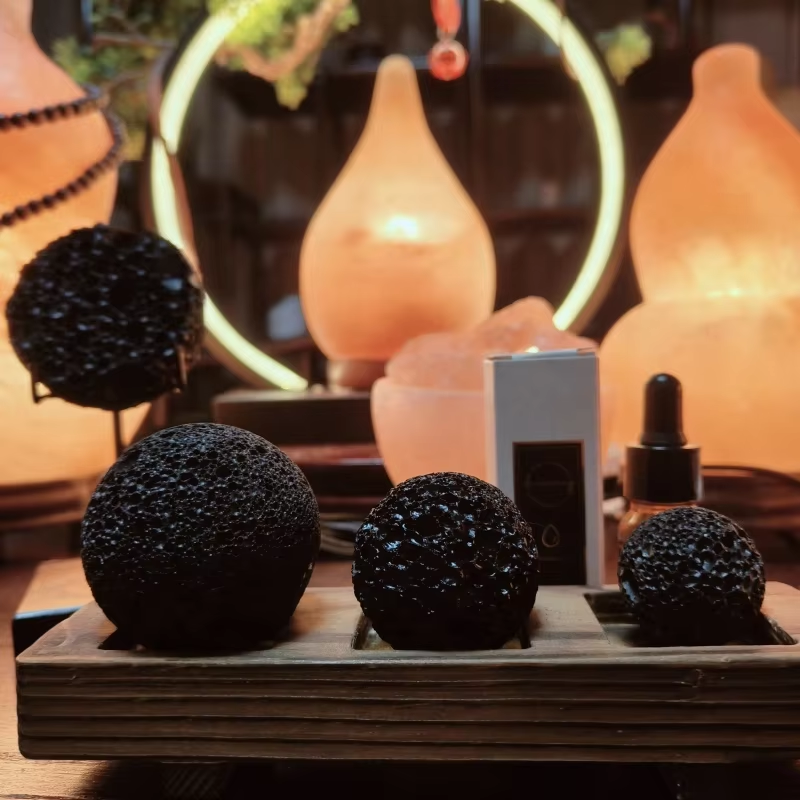
Most top manufacturers get their volcanic rock from areas where the geology is pretty stable, focusing on rocks with around 50 to 70 percent empty space inside them. This kind of porosity helps the essential oils absorb properly into the material. When the porosity isn't consistent across batches, the scents tend to spread out unevenly throughout products. That's why serious companies do thorough checks on their suppliers to make sure they're getting quality materials before any actual processing happens. Following these standards fits right into ISO 9001 certification requirements, and many businesses report cutting down on waste by roughly a fifth when compared to older manufacturing techniques.
The capillary action inherent in lava stone—driven by interconnected micro-pores formed during volcanic cooling—influences drilling depth and surface finishing in production. Stones with pore diameters between 0.5–2 mm demonstrate 89% higher essential oil retention in controlled tests, prompting factories to use laser-scanned quality gates that automatically reject nonconforming batches.
Facilities that are moving forward toward sustainability often reach carbon neutral status through systems that recycle water in closed loops and kilns powered by solar energy. These methods have been shown to slash energy usage by around 41% per unit according to the latest data from the 2024 Home Fragrance Sustainability Report. Most industry big shots, about 78%, work closely with quarries where local communities lead tree planting efforts. This partnership helps ensure that raw materials come from ethical sources while satisfying consumers who increasingly want their wellness products to be environmentally friendly. Nowadays, third-party evaluations looking at product lifecycles influence roughly two thirds of buying choices made at the best factories across the board.
In professional production settings, manufacturers tend to go for lava stones that have pores averaging between 0.25 and 0.5 microns in size. These dimensions help maximize capillary action so essential oils spread evenly throughout the stone. The ability of these stones to absorb natural materials usually ranges from around 15% to 20%, which has a real impact on how long scents last. Recent research published in 2024 actually backs this up quite well. For quality control purposes, many facilities now employ 3D imaging technology to check out the internal structure of each stone. Any pieces showing poor channel development or surface fractures deeper than 0.1mm just don't make the cut during final inspection processes.
| Material Property | Ideal Range | Testing Method | Performance Impact |
|---|---|---|---|
| Pore Size | 0.25–0.5 μm | SEM Imaging | Oil dispersion rate |
| Absorption Rate | 15–20% | Gravimetric | Scent duration |
Factories classify lava stones into three absorption tiers to match oil viscosity. High-viscosity oils like vetiver perform best with 18–22% absorption rates, while citrus oils are optimized for 12–15%. This targeted matching reduces oil residue buildup by 67% compared to ungraded materials, as verified in third-party lab testing.
Every production run goes through around 14 different quality tests. We check how products hold up against acids with pH levels from 2 to 12 for three full days straight. They also need to survive temperature swings between minus 20 degrees Celsius and boiling water conditions. Plus there's that UV test where samples sit under artificial sunlight equivalent to 500 real hours. All these steps help make sure almost all our shipments comply with those tough ASTM C616 requirements for genuine natural construction materials. Since implementing automated optical sorting systems back in 2022, most manufacturing sites report cutting down on quality issues by nearly 60%. Best part? The rocks still look like real rocks after all that testing.
Spectral analysis identifies mineralogical differences—such as basaltic versus andesitic lava—that affect oil interaction. Real-time algorithms adjust cutting machinery for density fluctuations up to ±0.7 g/cm³. Combined with blockchain-tracked sourcing, these techniques deliver 98% batch-to-batch consistency, supporting compliance with sustainable manufacturing certifications like ANSI/NSC 373.
Production starts off with picking out volcanic rock that has about 12 to 18 percent porosity because it soaks up oil just right. Before anything else happens, they run X-ray fluorescence tests to check if the minerals are consistent enough. Any batch with more than 0.3% impurities gets thrown out straight away. The real magic comes from advanced waterjet cutting machines which can hit tolerances within plus or minus 0.2 millimeters. Meanwhile, the automated assembly lines crank out around 2,400 units every hour and get things right almost all the time – talking about 99.8% accuracy there. All these improvements mean factories waste roughly 40% less material than older methods did according to research published on ScienceDirect back in 2022.
The diamond tipped CNC routers we use are really good at creating those fine textures that help distribute oils evenly across surfaces. After routing, our stones undergo a three-step tumbling process using different grades of ceramic media. This gets their surface roughness down to under Ra 1.6 micrometers which makes sure everything evaporates consistently. We run infrared scans on each piece to look at how uniform the pores are, and anything showing more than 15% difference in pore sizes just doesn't make the cut. Some studies indicate that all this attention to detail actually improves how well scents spread out compared to stones with uneven shapes, giving us around a 60% boost in efficiency according to what's been measured so far.
Vision systems powered by artificial intelligence can check around 200 different surface features each second, spotting tiny cracks that would completely escape notice from anyone looking with just their eyes. The robotic arms take care of most of the polishing work now, about 90 percent of it actually, and they keep the pressure really steady at plus or minus 0.05 psi which helps create a much smoother finish overall. Looking back since early 2020 when all this automation started getting implemented, there's been an incredible drop in defective products down to just 2% compared to before, and production rates have gone up twofold according to those third-party audit reports from manufacturing experts. These machines constantly monitor themselves too, making small tweaks to their settings roughly every 15 milliseconds so everything stays consistent even when running batches as big as 10 thousand units at once.
Factories run all sorts of tests to stop oils from breaking down over time. According to data from the Home Fragrance Safety Council released last year, around 8 out of 10 safety problems come from when people mix certain diffuser stones with acidic citrus oils without checking first. The testing process involves putting these stones through their paces with different pH levels ranging from something as acidic as lemon juice at pH 3.5 up to clary sage which hits about pH 9.3. During these accelerated aging tests, technicians look closely at how minerals might leach out and watch for any changes on the stone surfaces. This helps determine if the stones will stay stable over months or years and whether they'll actually preserve the chemical makeup of those precious essential oils.
Controlled chamber studies provide key performance benchmarks:
| Oil Type | Avg. Release Time | Intensity Peak (hr) | Residual Scent (%) |
|---|---|---|---|
| Citrus Blends | 5.2 hours | 1.8 | 34% |
| Floral Oils | 7.1 hours | 2.4 | 48% |
| Woody Essences | 9.6 hours | 3.7 | 62% |
These findings inform design choices—thinner stones (2–3mm) are used for fast-releasing citrus oils, while denser cuts (6–8mm) support sustained diffusion of woody essences like sandalwood.
In a recent 2023 test with about 500 people who couldn't see what they were testing, most folks (around 8 out of 10) preferred lava stones instead of those ceramic ones for spreading sandalwood scent around. But there was a problem with citrus oils - people weren't happy with them as much, maybe 19 percent less satisfied than expected. That got the research team thinking about ways to fix it, so they started working on special textures for surfaces that would hold onto those tricky volatile compounds better. What we're seeing here is basically how top manufacturers bring together what scientists know about materials and what actual customers want from their products in everyday life.
Standardized abrasion testing confirms structural integrity over 500+ usage cycles—three times more durable than pumice-based alternatives (Material Science Journal, 2023). Thermal shock protocols simulate climate extremes by cycling stones between 40°F and 120°F, verifying performance stability across diverse environments.
Proper maintenance extends functional life:
Factories implement blockchain-tracked quarrying systems to document origin and protect ecosystems. Independent audits confirm adherence to IUCN volcanic rock extraction standards (2024), ensuring habitat disruption remains below 2%. This traceability supports both environmental stewardship and consumer trust.
Solar-powered kilns cut energy use by 72% compared to traditional models, while closed-loop water systems save 12,000 gallons monthly per facility. As highlighted in sustainable stone production research, 89% of partner quarries fund community health programs through 5% mineral royalties—a practice increasingly required by eco-focused distributors.
 Hot News
2025-12-21
2025-12-15
2025-12-05
2025-12-02
2025-12-01
2025-11-19