EN
EN


Industrial filtration relies heavily on diatomaceous earth (DE) because of its natural silica composition and really good ability to hold onto tiny particles. What sets DE apart from man-made options is those ancient diatom skeletons that form a sort of microscopic sponge structure. These little fossils trap stuff down to about 1 micron in size without slowing things down too much. According to research published last year by EAG Industrial Materials Group, DE filters managed to remove 40% more turbidity than regular sand filters in city water treatment plants. The combination of this filtering power plus the fact that DE doesn't react chemically with most substances explains why so many manufacturers still turn to it when they need both clean results and fast processing times across various industrial applications.
What makes DE so effective? Well, it contains around 80 to 90 percent silica and those unique honeycomb shaped pores create electrostatic forces that grab onto stuff like colloids, bacteria particles, and all sorts of suspended solids without needing any chemicals mixed in. The material also has quite a large surface area, somewhere between 20 and 40 square meters per gram, which means it can pull out organic contaminants during beverage processing. This helps drinks meet those strict clarity requirements for things like juice products and spirits. Another bonus is that this whole process actually saves energy too. Studies at breweries have found that using DE instead of pressurized filtration systems cuts down on energy consumption by roughly 15 to 20 percent, making it both economically and environmentally advantageous for producers looking to cut costs while maintaining quality standards.
The city of Cincinnati saw something remarkable happen in their water treatment system last summer. Diatomaceous earth filters managed to knock down those pesky algal toxins by nearly 99% during the worst bloom season, way beyond what the EPA actually requires. Across the pond in France, one particular vineyard reported similar success stories. Their filtration system lasted twice as long between cleanings after switching to DE technology, which translated into saving around 120 thousand gallons of water waste each year. What makes this technology so interesting is how versatile it proves to be. Municipal plants rely on it for keeping harmful pathogens out of drinking water while small craft breweries find value in its ability to polish flavors without stripping away character from their specialty beers.
Manufacturers now engineer DE filters with calcined layers for over 10 reuse cycles, reducing waste by 70% (EAG, 2023). The 2023 EAG Industrial Materials Report details ceramic-DE hybrid systems that recover 95% of spent powder via backwashing. These innovations support circular economy goals while consistently delivering <2 NTU output in pharmaceutical-grade water applications.
When using diatomaceous earth containing at least 88% silica, facilities see fewer pressure drops across their systems and get around 30% longer filter run times before needing maintenance. Plants that pair this high silica content DE with automatic pre-coating equipment often find their operating expenses drop by about 25%. The reason? The layers form more consistently without breaking down as easily. For applications where purity matters most, such as making vaccines, DE rich in silica can reach filtration down to 0.1 microns. This level of performance meets those strict FDA requirements outlined in CFR Title 21, which is non-negotiable for many pharmaceutical operations these days.
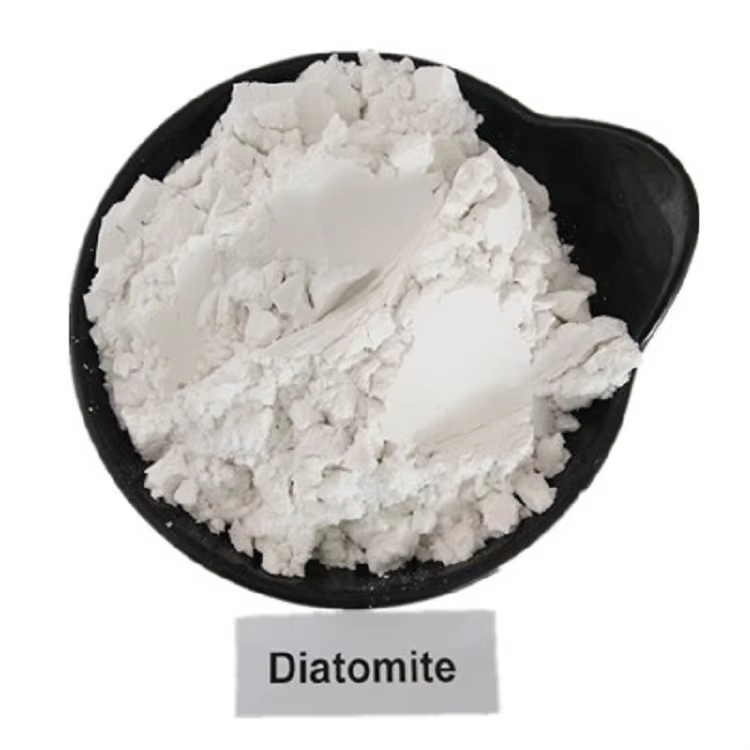
Diatomaceous earth enhances industrial coatings through its high silica content (85—94%) and porous microstructure. Its chemical inertness prevents unwanted reactions with organic binders in water-based formulations, improving pigment dispersion and adhesion. The granular texture also increases coating permeability, enabling faster drying times—crucial for high-volume manufacturing environments.
Amorphous silica within diatomaceous earth creates hydrophobic barriers that keep moisture away from epoxy and polyurethane coatings. The way silica scatters UV light cuts down on polymer breakdown quite significantly, maybe around half or so. Plus, it handles heat changes better than many other materials, which means less damage when temperatures swing back and forth. Because of these characteristics, coatings boosted with DE work really well outdoors where they face all sorts of tough weather conditions like rain, sun exposure, and extreme cold or heat.
Coating systems containing DE additives stand out for their improved protection against saltwater corrosion problems. What makes these materials work so well is their ability to soak up chlorides and moisture before these corrosive elements can get to the actual metal surfaces underneath. Many shipbuilders report that this means less frequent maintenance checks, sometimes stretching those intervals by around two years give or take depending on conditions. Car makers have also started using DE technology in the coatings applied to vehicle underbodies. This helps counteract the effects of road salt during winter months, cutting down on rust spots forming over time. The best part? Manufacturers don't need to depend on traditional zinc based solutions anymore for this kind of protection.
Diatomaceous earth has become really important for industrial filtration because of how porous it is and how well it captures particles ranging from 1 to 40 microns in size. When compared to synthetic options, diatomaceous earth works better in industries where precision matters most, like making medicines or processing food products. According to some recent research published in 2024 on filtration effectiveness, systems using DE can reduce cloudiness (turbidity) down to almost 99.8%, which is pretty amazing considering they still manage to keep water flowing at speeds about 25% quicker than what we see with polymer membranes.
DE’s performance is driven by three key characteristics:
The City of Phoenix reduced chemical usage by 40% after implementing DE filtration in 2022, while a leading European brewery achieved 30% longer filter cycles using calcined DE. These outcomes underscore DE’s scalability across diverse purification demands.
Recent developments include regenerative DE filters that cut waste by 70% through thermal reactivation, bio-composite variants combining DE with chitosan for enhanced heavy metal capture, and pilot programs demonstrating 86% efficiency in PFAS removal during preliminary trials.
Plant managers observe 18—22% longer filter runs when using DE with ≥92% silica compared to standard grades. This premium material is especially valuable in facilities requiring USP Purified Water standards, where consistent feedwater quality directly impacts production yields and regulatory compliance.
Diatomaceous earth works really well for light abrasive tasks because it has lots of silica in it (around 87 to 91 percent SiO₂) and isn't too hard on the Mohs scale either, somewhere between 4.5 and 5.5. The shape of these particles is kind of jagged and they have tiny holes all over them, which makes them great at taking away oxidation spots and leftover paint without scratching up softer metals. That's actually one big plus compared to other abrasives that are much rougher on surfaces. When used in automated setups, diatomaceous earth can take off material at a pretty consistent rate, usually around 0.1 to 0.3 micrometers per pass according to tests done in the aerospace industry for polishing parts.
More than two thirds of metal finishing shops have started adding DE to their polishing pastes when working on stainless steel parts, aluminum surfaces, and brass components these days. Mix it with some fatty acid carrier oils and what happens? The result is pretty consistent scratch patterns that match around 400 to 3,000 grit sandpaper results. For companies looking to save money without sacrificing quality too much, this means they can replace expensive diamond compounds in certain situations. Think about things like restaurant kitchen equipment where appearance matters but not perfection, or decorative metal elements on buildings where nobody will notice minor imperfections anyway.
For semiconductor and medical device manufacturing, calibrated DE blends achieve surface roughness values of 0.02—0.05 Ra—improving finish quality by 40% over traditional pumice systems. With particle sizes typically ranging from 10—50 μm, DE minimizes subsurface damage in titanium alloys while supporting throughput rates of 8—12 components per hour in automated deburring lines.
Diatomaceous earth (DE) has become indispensable across diverse industrial sectors due to its unique physical properties and cost-efficiency. Its porous structure and functional versatility extend beyond filtration into pharmaceuticals, food processing, and advanced materials engineering.
In pharmaceutical manufacturing, DE’s inertness and high absorption capacity make it ideal for binding active ingredients in tablets and encapsulating temperature-sensitive compounds. A 2024 industry report highlights its ability to improve dissolution rates by up to 40% in time-release medications while meeting strict FDA purity standards.
DE ensures clarity and stability in consumables such as beer, edible oils, and powdered spices. Research from food safety authorities confirms its superiority in removing sub-micron particulates during juice filtration, reducing turbidity by 99.7% without altering flavor profiles.
Automotive engineers are integrating DE into brake pads, soundproofing foams, and epoxy composites. A 2024 materials innovation study shows DE-reinforced polymers reduce component weight by 15% while maintaining structural integrity under extreme temperatures—supporting global efforts to adopt lightweight, sustainable materials in electric vehicle design.
 Hot News
2025-12-21
2025-12-15
2025-12-05
2025-12-02
2025-12-01
2025-11-19